Wow, so I maintain a blog, huh? You mean to say that I regularly write entries and manage a website that I happen to be very proud of and hope to use as part of my portfolio when I want to get into a PhD program? You don't say...
Alright, enough beating myself up about not maintaining this thing lately. I obviously went on a hiatus. I hope you all can forgive me.
Enough about that. Let's talk about new media.
I'm getting really sick of everyone mocking Twitter or downplaying it as usefulness. Yes, a lot of it is mundane, trite, self-indulgent, abbreviated prattle that doesn't do anyone any amount of good, save establish a user's presence in a community. But hold on. Even something as seemingly insignificant as presence means so much in an online environment, especially since virtual environments are increasingly becoming appendages to our real world interactions and selves.
There are obviously negative and positive aspects to the information digital age, where to access headlines, statistics, biographical information, and wikis allows anyone with Internet connection a chance to obtain as much knowledge as they know how to get their eyes on. While unfettered access to information allows almost every literate individual the right and possibility of a self-fueled education, not everyone is going to take advantage of these tools of unlimited access. Only those who want to participate will participate, only those who want to start a conversation will start on. The category of an engaged virtual participator only applies to a very small percentage of individuals who have high efficacy in their involvement in a community setting in the first place. Those who make the effort to establish their presence in a community, be it actual or in the ether, are few and far between. Think of activists. Think of religious fanatics. Think of hard-core sports nuts. How many of us really know someone, in real life, who is whole-heartedly dedicated to an extremist lifestyle? And these extreme life-participants now exist in another form: the extreme virtual participant.
I have only a handful of friends who regularly post interesting news stories to their Facebook pages, and maybe just as many whose profile photo is in a constant state of flux. Almost all of my Facebook friends, however, utilize the status update tool, seemingly as a way of establishing their presence in this community. The difference between those who post breaking or interesting headlines on their pages and those who constantly change their "About Me" sections is actually quite minimal when it comes down to it: both of these groups from assumed extreme opposite spectrums are simply overtly and unabashedly establishing their virtual presence in a community. And in some cases, their presence is quite similar to what it would be in face-to-face interaction. Not always, but in some cases, our virtual selves mirror our realities.
Some don't attempt to depict themselves in the ether because they are tentative about putting their information out there for all to see -- proof that shyness does indeed plague those in a seemingly objective and open online world -- while some simply don't see the point. I believe that those who are so adamantly against Twitter fall into the latter category of those who just don't see the point. And sometimes, I don't either.
But I don't think that it matters that we all understand everyone's personal need or desire to blog, to tweet, or to connect on Facebook. I don't think that chalking it up to narcissism and self-indulgence is fair. I posted something on my Facebook page about how Iranians are spreading news via Twitter, and one friend quipped "Cuz that's what the vast majority of people use it for." Both extremes of the argument are, I feel, inaccurate: to say that everyone uses Twitter and other social networking sites for the dissemination of information would be an optimistic fallacy; to say that everyone uses these sites to tell their friends what kind of sandwich they ate at lunch is equally unfair. I think it is most fair to say that Twitter offers possibilities for freedom of speech and access to information, which is admittedly a fairly neutral statement. But to avoid sounding too polarized -- too praising or too negative -- I think that the conversation of what Twitter and other social networking sites can do is far more productive than straight up negations or praise.
Because these sites and the possibility of a democratic (mostly) virtual presence is all so new, people are still trying out the waters. We all saw how quickly Myspace fell into the depths of the Dark Side of the Internet, and who knows how much longer it will be before Facebook gives way to a social networking site with a more user-friendly interface and better privacy settings? Twitter could easily go the way of the LiveJournal any time soon, but for the time being, I'm going to play around with my presence on the site as much as I can.
Showing posts with label Mechanical Reproduction. Show all posts
Showing posts with label Mechanical Reproduction. Show all posts
Wednesday, June 24, 2009

Monday, May 18, 2009
Lessig : Helprin :: remix : extended terms of copyright (that's right, I just got all sorts of SAT on you)
So this guy Mark Helprin writes this article for the New York Times that argues for an extension of copyright restrictions past the current 70 years. He also has somewhat of a different view on what it means to have work copyrighted, and brings up interesting points on the difference between an idea and a work of art. He talks about the article, and his book Digital Barbarism in an episode of All Things Considered. Lawrence Lessig then responds to Mark Helprin's argument by making a page on his wiki so that his followers can work together to create a response, and goes on All Things Considered to clearly state why what Helprin is trying to say is met with so much grief by so many individuals (you can find this on the same page as the ATC episode with Helprin under the link "Lawrence Lessig responds to Mark Helprin's argument").
We were asked to respond to this for a final in my Media Industry Perspectives class. Below is my response and which side of the argument I advocate.
---
I completely agree that the current state of copyright law not only restricts creativity, but also, in line with Lessig’s statements made on NPR’s All Things Considered, that copyright as an overall system has failed to fulfill its intended results in the 21st century digital world. In his interview with Jackie Lyden on NPR, Lessig informs listeners that when Google set out to digitize 18 million books, they found that 75% of these books were in an uncertain status of copyright. They were out of print, and yet whether or not they were still under copyright protection or were in fact the stuff of public domain was indeterminate. This proves that the current state of copyright that is intended to recognize the original author is failing to do its most basic and simple job properly. The laws surrounding copyright and ownership are so muddy that Lessig has based his career around making these laws and regulations simpler to understand, and wishes to make negotiations flexible and comprehensible for the average layman who has his work protected under copyright.
In (not direct) opposition to Lawrence Lessig’s work and his books The Future of Ideas and Remix, author Mark Helprin argues in his article from the New York Times and his book Digital Barbarism that Congress should continue to extend copyright terms from the existing 70 years to, in his words, “as far as it can throw”. He believes that the children and grandchildren who inherit the copyright and the money involved in the royalties made from that copyright of a predecessor’s work should be seen as equivalent to the generations who inherit the property rights to a family mill. Lessig refutes this position, stating that, obviously, these two pieces of property are very different, and that Helprin’s argument is inherently faulty for being based on these grounds. Helprin’s article received over half a million negative comments from the online community, mostly from those who in theory align with Lessig and his ideas on public domain, intellectual property, and what it means to create and share in a digital world. Along with the aforementioned NPR appearance, Lessig also responded to Helprin’s article by creating a page entitled “Against perpetual copyright” on The Lessig Wiki, a community site intended to discuss ideas, praises and criticism surrounding Lessig’s work.
While Helprin and Lessig are not entirely diametrically opposed (they both do not wish for the current state of peer-to-many free file sharing to continue, for example), they do have many differing opinions on intellectual property rights, the definition of art and creativity in general, and their interpretation of legislation. One of their differences of opinion lies in their individual interpretation of the line in the US Constitution surrounding copyright. This particular line states the length of any given copyright should only exist “for limited Times”. Lessig understands “limited” to mean minimal, and believes that Congress extending the length of protected copyright on a work 11 times in the past 40 years is making a joke of the US Constitution and only serves to put more money in the hands of those who are profiting off of the protection of the work; on the other hand, Helprin takes the term “limited” to be extremely flexible and subjective, and while he has never said that he advocates perpetual copyright, he certainly believes that as long as copyright law is up for renewal and extension, Congress should take advantage of this open interpretation of the Constitution.
Another area where Lessig and Helprin disagree is on the concept of “remixing” existing works into new, appropriated pieces of art. In his interview on NPR, Helprin states that “remix is a nightmare”, and while he probably means this only in relation to legal issues, this statement serves to make Helprin look like a naysayer and a curmudgeon who refuses to accept the evolving states of art and media that come with evolving technologies. Helprin believes that the work one creates is sacred and should not be altered in any way without the original author’s permission. I certainly advocate Lessig’s ideas surrounding the issue, and believe that current copyright laws need to evolve with and not against the current trends in technology and waves of creativity.
We were asked to respond to this for a final in my Media Industry Perspectives class. Below is my response and which side of the argument I advocate.
---
I completely agree that the current state of copyright law not only restricts creativity, but also, in line with Lessig’s statements made on NPR’s All Things Considered, that copyright as an overall system has failed to fulfill its intended results in the 21st century digital world. In his interview with Jackie Lyden on NPR, Lessig informs listeners that when Google set out to digitize 18 million books, they found that 75% of these books were in an uncertain status of copyright. They were out of print, and yet whether or not they were still under copyright protection or were in fact the stuff of public domain was indeterminate. This proves that the current state of copyright that is intended to recognize the original author is failing to do its most basic and simple job properly. The laws surrounding copyright and ownership are so muddy that Lessig has based his career around making these laws and regulations simpler to understand, and wishes to make negotiations flexible and comprehensible for the average layman who has his work protected under copyright.
In (not direct) opposition to Lawrence Lessig’s work and his books The Future of Ideas and Remix, author Mark Helprin argues in his article from the New York Times and his book Digital Barbarism that Congress should continue to extend copyright terms from the existing 70 years to, in his words, “as far as it can throw”. He believes that the children and grandchildren who inherit the copyright and the money involved in the royalties made from that copyright of a predecessor’s work should be seen as equivalent to the generations who inherit the property rights to a family mill. Lessig refutes this position, stating that, obviously, these two pieces of property are very different, and that Helprin’s argument is inherently faulty for being based on these grounds. Helprin’s article received over half a million negative comments from the online community, mostly from those who in theory align with Lessig and his ideas on public domain, intellectual property, and what it means to create and share in a digital world. Along with the aforementioned NPR appearance, Lessig also responded to Helprin’s article by creating a page entitled “Against perpetual copyright” on The Lessig Wiki, a community site intended to discuss ideas, praises and criticism surrounding Lessig’s work.
While Helprin and Lessig are not entirely diametrically opposed (they both do not wish for the current state of peer-to-many free file sharing to continue, for example), they do have many differing opinions on intellectual property rights, the definition of art and creativity in general, and their interpretation of legislation. One of their differences of opinion lies in their individual interpretation of the line in the US Constitution surrounding copyright. This particular line states the length of any given copyright should only exist “for limited Times”. Lessig understands “limited” to mean minimal, and believes that Congress extending the length of protected copyright on a work 11 times in the past 40 years is making a joke of the US Constitution and only serves to put more money in the hands of those who are profiting off of the protection of the work; on the other hand, Helprin takes the term “limited” to be extremely flexible and subjective, and while he has never said that he advocates perpetual copyright, he certainly believes that as long as copyright law is up for renewal and extension, Congress should take advantage of this open interpretation of the Constitution.
Another area where Lessig and Helprin disagree is on the concept of “remixing” existing works into new, appropriated pieces of art. In his interview on NPR, Helprin states that “remix is a nightmare”, and while he probably means this only in relation to legal issues, this statement serves to make Helprin look like a naysayer and a curmudgeon who refuses to accept the evolving states of art and media that come with evolving technologies. Helprin believes that the work one creates is sacred and should not be altered in any way without the original author’s permission. I certainly advocate Lessig’s ideas surrounding the issue, and believe that current copyright laws need to evolve with and not against the current trends in technology and waves of creativity.
Monday, December 8, 2008
Baudrillard and Benjamin: Media and Experience v. Postmodernity
I found several similarities between Baudrillard's "The Precession of Simulacra" and Benjamin's "The Work of Art..."; at least, I believe them to be similarities. Baudrillard essentially states that the reparation of an artifact is merely a restoration of its "visible order"; we cannot, however, restore original mythical intent (459). This concept of visible order and this original intent is quite similar to Benjamin's idea of the aura, which he believes is destroyed in a work of art by its reproduction. One can never replicate the feeling that is created by an original work of art; it is for this reason Baudrillard states "Ramses does not signify anything for us" and he never will, for no one who is alive today ever knew him, nor can anyone ever comprehend his significance fully (459). Only through a recreation, a simulation, of written and oral history can we ever attempt to know the significance or the meaning of a mummy, and for that matter a static, almost mummified work of art.
Baudrillard also questions what then happens to divinity when there is multiplication of divine icons much like when Benjamin questions what happens to aura (which could be argued to be the equivalence of a kind of divinity, a kind of intangible essence) with reproduction. Is this why Muhammad is not allowed to be turned into icon in the form of a drawing or a likeness in Islamic tradition, because of the fear of the loss of divinity in multiplication and representation? There is a fear in the Islamic religion that visual depictions of the prophet will lead to idolatry, which could also be seen as the worshiping of the simulacra of Muhammad as opposed to the reality of Muhammad.
Baudrillard also questions what then happens to divinity when there is multiplication of divine icons much like when Benjamin questions what happens to aura (which could be argued to be the equivalence of a kind of divinity, a kind of intangible essence) with reproduction. Is this why Muhammad is not allowed to be turned into icon in the form of a drawing or a likeness in Islamic tradition, because of the fear of the loss of divinity in multiplication and representation? There is a fear in the Islamic religion that visual depictions of the prophet will lead to idolatry, which could also be seen as the worshiping of the simulacra of Muhammad as opposed to the reality of Muhammad.
Friday, October 10, 2008
The Metropolitan Museum of Art's British Prints Exhibit
 I went to the Metropolitan Museum of Art today for the first time. Along with visiting the permanent photography, Egyptian, Mesopotamian, impressionist, and modern art sections of the Museum, we made our last stop in the newest exhibit entitled Rhythms of Modern Life: British Prints 1914-1939. I was anticipating this all day, and usually when I think too much about something and build it up in my head it never turns out to be as wonderful as I hope. But this was just fantastic.
The amount of effort that goes into each print is astounding, from the cutting of the material for each layer of color to the actual act of printmaking (thanks to my brother, I have screen printing experience, and let me tell you it's a laborious, repetitive and painstaking process).

Four or five artists were prominently featured in the exhibit, three of which were Edward Wadsworth, Sybil Andrews, and my favorite, Cyril E. Power. Power's work obviously made the biggest impression on me: all of the images featured in this entry were done by him. This printmaking movement in Britain represented a shift that contributed to Futurism, and the dynamism of each of these images evoke movement, industry, enhanced and warped perspective, and undeniable beauty. Hopefully this entry will inspire you to check out more stuff by Power and the others I cited in this entry. Another prominent artist whose images were full of vectors and geometric shapes was C.R.W. Nevinson, although I wasn't as impressed with his use of color as I was with Power.

This exhibit also brought thoughts of Benjamin to mind, since every one of these images is not the only one of its kind. Printmaking is an art form that can only be realized in an age of reproduction, yet that reproduction doesn't have to be mechanical. My experience with printmaking was done by hand. I understand that almost every printed t-shirt was made by a silk screen machine, but there are ways of making prints that are completely hand done. There was a covered display table in the center of one of the rooms that held the tools used to make a lithograph, which is indeed a very hands-on process, making printmaking seem to be more of a craft than a means of mass reproduction. There were two "identical" Cyril prints, each made from the same lithograph, side by side on the wall and the differences were astounding. Not one of any of these prints are identical, which I think adds to their individuality and thus their overall aura.
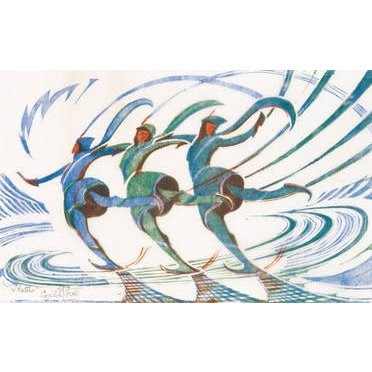
Another thing I loved about Power's work was that he signed, in pencil, each one of his prints, and also marked which number each print represented in the series. Not only did each print bare the mark of its maker, but these markings contributed a certain aura to an image that some might consider to be void of the presence of the artist. If you look hard enough, you can see all of Power's markings in the corners of his images.
Sunday, October 5, 2008
More on Benjamin
I find interesting the modern day decline of theater attendance and the rise in popularity and some might say the superiority of watching a filmic performance vs. a live one. This goes into matters surrounding portability, accessibility, potential for reviewing, presentation of a concrete entity, etc. which I do not wish to argue at this time...
Because of the nature of film, an actor's performance is split into episodes, and is thus never a cohesive unit. Scenes can occur in different times and places but be made to look as one time, one place. This is a contrivance of authenticity.
I am taking authenticity as Benjamin utilizes it throughout his work to mean "original intention." In this same way, the Mona Lisa that has been mechanically reproduced and printed on, say, a t-shirt or postcard is not authentic; it is authentically a replication, authentically a t-shirt or a postcard. But it is in no way being presented with the original intention of the image in mind. If da Vinci were to see his image reduced or enlarged to fit on a postcard that will eventually be discarded or a t shirt that will eventually fade and meet the same demise as the postcard, who knows what he would think.
Back to the cinema: while a film is presented as a narrative, it is never filmed as one, with minor exceptions (think of Hitchcock's Rope [1948], but even this has 3 or 4 cuts.) Rope, as with most early films, was originally intended for the stage. One could say that Hitchcock attempted to stick with the authentic version of this script, one that was originally intended to be presented on the stage.
But a story that was writing for the stage, in Benjamin's opinion, should stay on the stage. Moving the theater-intended script into the realm of screenplay, moving on-stage action into the realm of on-camera action is reproducing a piece of art without authenticity because its original intention has been lost. The Odd Couple works great on a stage; translated into film it is not authentically what Neil Simon's original intent was, even though he had a hand in rewriting the play for the screen. I am not saying that a mechanical reproduction that is not "authentic" (that is, used or presented in terms of its original intent) is good or bad, and I don't think Benjamin is either. He is, however, saying that there is a definite loss of aura, a loss of original time and place, and therefore a loss of original intention of the piece of art.
Because of the nature of film, an actor's performance is split into episodes, and is thus never a cohesive unit. Scenes can occur in different times and places but be made to look as one time, one place. This is a contrivance of authenticity.
I am taking authenticity as Benjamin utilizes it throughout his work to mean "original intention." In this same way, the Mona Lisa that has been mechanically reproduced and printed on, say, a t-shirt or postcard is not authentic; it is authentically a replication, authentically a t-shirt or a postcard. But it is in no way being presented with the original intention of the image in mind. If da Vinci were to see his image reduced or enlarged to fit on a postcard that will eventually be discarded or a t shirt that will eventually fade and meet the same demise as the postcard, who knows what he would think.
Back to the cinema: while a film is presented as a narrative, it is never filmed as one, with minor exceptions (think of Hitchcock's Rope [1948], but even this has 3 or 4 cuts.) Rope, as with most early films, was originally intended for the stage. One could say that Hitchcock attempted to stick with the authentic version of this script, one that was originally intended to be presented on the stage.
But a story that was writing for the stage, in Benjamin's opinion, should stay on the stage. Moving the theater-intended script into the realm of screenplay, moving on-stage action into the realm of on-camera action is reproducing a piece of art without authenticity because its original intention has been lost. The Odd Couple works great on a stage; translated into film it is not authentically what Neil Simon's original intent was, even though he had a hand in rewriting the play for the screen. I am not saying that a mechanical reproduction that is not "authentic" (that is, used or presented in terms of its original intent) is good or bad, and I don't think Benjamin is either. He is, however, saying that there is a definite loss of aura, a loss of original time and place, and therefore a loss of original intention of the piece of art.
Tuesday, September 30, 2008
Walter Benjamin
"The Work of Art in the Age of Mechanical Reproduction", Illuminations. New York: Schocken Books, 1969.
((To read this essay, which I highly recommend to everyone, scroll down to the line that starts with "Our fine arts were developed,..." here. While it's long, it's certainly worth reading. Don't ignore the end notes.))
This text says much on film, actors, the apparatus of the camera, spectatorship and the politics of evolving art. I'm very exciting to be rereading Benjamin, especially since most of what he has to say relates directly to film. In order to get a better understanding of Benjamin's overall message I went through and attempted to title each of the sections for the sake of extracting his many ideas. Here is what I came up with:
I - Reproduction
II - Time and Space
III - Changes in History and Nature
IV - Ritual, and Purity
V - Cult Value vs. Exhibition Value
VI - Aura
VII - Is Film Art?
VIII - Identification with the Apparatus
IX - The Actor as a Shadow
X - The Cult of the 'Captured'
XI - Detachment, The Surgeon vs. the Magician
XII - Collective Experience
XIII - The Camera's Revelations
XIV - Dadaism, and Shock Effect
XV - Distraction, Architecture
(These titles help me organize the essay into segments)
While his thesis is centrally surrounded by the concept of the changing nature of "the politics of art" (19) in times of technological development, these fifteen subsections can very well function as his other central themes.
The question Is film art?, however, comes up several times throughout the piece. Benjamin quotes Duhamel both in the main text and in the end notes. Duhamel says of film: "[it is] a past time for helots...a spectacle which requires no concentration and presupposes no intelligence" (32). On the other hand, Benjamin calls Duhamel "[a man] who detests the film and knows nothing of its significance" (32). Benjamin stands up for film as art throughout this entire piece while also going on to say more; Benjamin recognizes the things that the camera opens to us are far greater than those things available to the human eye. He believes that mechanically reproduced work can be art with photography and film, and it redefines art. In the endnotes Benjamin extrapolates on the idea that "the boldness of the cameraman is indeed comparable to that of the surgeon," (39) recognizing the artistry, the nibble hand work, and the intricacies involved in the making of a motion picture.
I can't wait to explore the concept of the aura further in a future post...
((To read this essay, which I highly recommend to everyone, scroll down to the line that starts with "Our fine arts were developed,..." here. While it's long, it's certainly worth reading. Don't ignore the end notes.))
This text says much on film, actors, the apparatus of the camera, spectatorship and the politics of evolving art. I'm very exciting to be rereading Benjamin, especially since most of what he has to say relates directly to film. In order to get a better understanding of Benjamin's overall message I went through and attempted to title each of the sections for the sake of extracting his many ideas. Here is what I came up with:
I - Reproduction
II - Time and Space
III - Changes in History and Nature
IV - Ritual, and Purity
V - Cult Value vs. Exhibition Value
VI - Aura
VII - Is Film Art?
VIII - Identification with the Apparatus
IX - The Actor as a Shadow
X - The Cult of the 'Captured'
XI - Detachment, The Surgeon vs. the Magician
XII - Collective Experience
XIII - The Camera's Revelations
XIV - Dadaism, and Shock Effect
XV - Distraction, Architecture
(These titles help me organize the essay into segments)
While his thesis is centrally surrounded by the concept of the changing nature of "the politics of art" (19) in times of technological development, these fifteen subsections can very well function as his other central themes.
The question Is film art?, however, comes up several times throughout the piece. Benjamin quotes Duhamel both in the main text and in the end notes. Duhamel says of film: "[it is] a past time for helots...a spectacle which requires no concentration and presupposes no intelligence" (32). On the other hand, Benjamin calls Duhamel "[a man] who detests the film and knows nothing of its significance" (32). Benjamin stands up for film as art throughout this entire piece while also going on to say more; Benjamin recognizes the things that the camera opens to us are far greater than those things available to the human eye. He believes that mechanically reproduced work can be art with photography and film, and it redefines art. In the endnotes Benjamin extrapolates on the idea that "the boldness of the cameraman is indeed comparable to that of the surgeon," (39) recognizing the artistry, the nibble hand work, and the intricacies involved in the making of a motion picture.
I can't wait to explore the concept of the aura further in a future post...
Subscribe to:
Posts (Atom)