Cross-posted on Immanent Terrain
Perhaps because I was so completely taken by the Marina Abramovic exhibit at MoMA last week - I'm still thinking about it and still bring it up in conversation with friends back in California - I found it difficult to process all of the information thrown at me at the Whitney Museum's Biennial show last Friday, April 30th. Only almost a week later have I been able to reflect on what I had seen and what struck me and remained imprinted on my memory.
I showed up at the museum equipped with the knowledge of one, maybe two of the artists whose work was on display, completely unfamiliar with the rest of the pieces and the artists in the show and completely unassuming in what to expect. I'd heard a lot of hype, namely that this year's show was the best in ages, but digesting this hype felt similar to times when friends have told me that a film is "amazing" or "hilaaarious!" - I knew that expecting too much could potentially disappoint. I suppose that since this show is supposed to be the show that features the next big stars of the art world I should have done a bit more research - but honestly, wandering the labyrinth of temporary walls and installations with a map and a checklist wouldn't have done me any good at all. Instead, coming in blindly allowed me to stay longer when I wanted to stay and move on quickly when something didn't catch my attention or peak my interest.
Having the collective experience of viewing the Bruce High Quality Foundation's piece I Like America and America Likes Me was a unique moment in the visit, being the first and last time that all seven of us experienced a piece together through interaction and conversation. I don't know that everyone was equally intrigued by this piece, nor am I asserting that everyone will remember it - but from this point on, after viewing the BHQF's Hearse converted into an ambulance with the windshield functioning as a screen for a slightly distorted video piece, each of us will have a unique selective memory of those pieces of art that matter the most to us for one reason or another. For that first shared experience, we all were able to experience something together, although this is not to say that all of our experiences were the same nor that all of our memories of the shared experience will be the same.
Fascinating, though, how each of us will come away from this and write something different about potentially disparate or potentially the same works. After we all parted ways and completely lost track of each other, each of us were able to take as much time as we needed looking at every piece of art that interested us, in a way being allowed to choose the most desired path for our own unique experiences. I had several passing moments with everyone, "dancing" with Susana a few times, sitting silently next to Caldwell during Kerry Tribe's video piece HM (which I fully intend to write more about once I feel that I can effectively compare it to Bergson), but rarely speaking with any of them in the hopes of maintaining our own unique, uninterrupted experiences. I don't necessarily enjoy conversing at a museum anyway both for fear of being rude or disturbing other patrons and the desire to quietly contemplate and live in the moment. This is why I agree with Sam's point that museums and art in general are sometimes best experienced alone - I think that Brian trying to be friendly and speak to a completely engrossed and therefore barely responsive version of myself while I was watching Abramovic's Rest Energy at MoMA is a testament to the point that art is sometimes best experienced in solitude - but, this is not to discourage the potential for an enlightened, collaborative conversation afterward.
Showing posts with label So I think I know something about art.... Show all posts
Showing posts with label So I think I know something about art.... Show all posts
Sunday, May 9, 2010

Wednesday, April 28, 2010
The Artist is Present: Marina Abramovic and Relational Aesthetics
(cross-posted on Immanent Terrain)
It was nothing short of a profoundly unique experience to witness Marina Abramovic's retrospective at the Museum of Modern Art on Saturday, April 24th, 2010. I say this not just because of the profound impact that her work left on me for the days after witnessing the re-performances and re-presentations of her literal "body of work"; this experience was novel as it was the first time MoMA has curated a retrospective on the oeuvre of a performance artist.
I had an inclining of what to expect after having lunch with my artist friend on the Wednesday prior to visiting the museum. She explained the piece that Abramovic herself was to be performing on the second floor of the museum, The Artist is Present, as the artist's ultimate work. My artist friend's explanation served to be a far more modest, cursory description of the performance, as the experience is far more serene yet grand than she made it out to be. Upon entering the museum and ascending the stairs to the Marron Atrium that exists as a space traditionally in constant flux exhibiting temporary collections, large-scale pieces, and video installations, one encounters massive floodlights at each of the four corners of a large square marked off on the floor by tape, the square almost the size of the space itself. In the center of the square sits Abramovic on a chair at one end of a wooden table wearing a long, red gown that is simultaneously confining her body and yet somehow cascading around her legs and onto the floor, making herself at once separate from and one with the chair on which she is positioned. There is a chair positioned at the other end of the table facing the artist in which museum visitors are invited to sit and engage in an unspoken dialogue with the artist for an indeterminate amount of time. Her body appears in this same position every day for the length of museum hours until the retrospective closes on May 31, 2010.
Endurance is a large part of Marina Abramovic's presentation of her body/of work. Sitting or standing for hours at a time, subjecting her body to repeatedly to collisions with other objects, beatings, lashings or deprivation, Abramovic tests the limits of human comfort with acts of tedium, stress, and concentration. As she submits her body to these series of acts - examples can be drawn from her three parallel pieces from 1977 entitled Freeing the Memory, Freeing the Body, and Freeing the Voice in which she speaks, dances and screams until she has pushed her body to the point of failure - Abramovic seeks to push her body out of its comfort of stasis and stagnant, un-becoming being. In committing to performing these acts in front of a live audience (or at times the future audience implied in the act of filming the performance), the artist insists on creating a dialogue with herself and her audience, creating herself as both the subject and the object of her body/of work. Much like her piece The Artist is Present, Abramovic questions the notions of object and subject and of artistic and audience.
If, as Nicolas Bourriaud asserts in his text Relational Aesthetics, "each particular artwork is a proposal to live in a shared world, and the work of every artist is a bundle of relations with the world,"(i) then Abramovic's aim of blurring the line between artist as subject and audience as object (and vice versa) lies in her confrontation of her body with the spectator. Consistently appearing nude without engaging in sexual acts and subjecting her body to the will of her audience like she did with Rhythm O - asking the audience to use one of 70 or so different objects, some of them potentially lethal, on herself and taking full responsibility - the artist is confronting her audience's notions of the body and of the traditional work of art while at the same time dispelling concepts of sexuality and humanity.

"I didn't have verbal communication. It was only with the eyes. I became so sensitive that—it sounds almost religious—I had this amazing opening of the heart that hurt me. This is why I believe time is so necessary: the public needs time to get the point. When I spend 12 days in a gallery, its energy is changed. Artists have to serve as oxygen to society, and that is what I do." - Marina Abramovic, from an interview for ARTnews.
(i) Nicolas Bourriaud. Relational Aesthetics. France: Les presses du reel, 1998 (22).
(ii) Ibid, 15.
It was nothing short of a profoundly unique experience to witness Marina Abramovic's retrospective at the Museum of Modern Art on Saturday, April 24th, 2010. I say this not just because of the profound impact that her work left on me for the days after witnessing the re-performances and re-presentations of her literal "body of work"; this experience was novel as it was the first time MoMA has curated a retrospective on the oeuvre of a performance artist.
I had an inclining of what to expect after having lunch with my artist friend on the Wednesday prior to visiting the museum. She explained the piece that Abramovic herself was to be performing on the second floor of the museum, The Artist is Present, as the artist's ultimate work. My artist friend's explanation served to be a far more modest, cursory description of the performance, as the experience is far more serene yet grand than she made it out to be. Upon entering the museum and ascending the stairs to the Marron Atrium that exists as a space traditionally in constant flux exhibiting temporary collections, large-scale pieces, and video installations, one encounters massive floodlights at each of the four corners of a large square marked off on the floor by tape, the square almost the size of the space itself. In the center of the square sits Abramovic on a chair at one end of a wooden table wearing a long, red gown that is simultaneously confining her body and yet somehow cascading around her legs and onto the floor, making herself at once separate from and one with the chair on which she is positioned. There is a chair positioned at the other end of the table facing the artist in which museum visitors are invited to sit and engage in an unspoken dialogue with the artist for an indeterminate amount of time. Her body appears in this same position every day for the length of museum hours until the retrospective closes on May 31, 2010.
Endurance is a large part of Marina Abramovic's presentation of her body/of work. Sitting or standing for hours at a time, subjecting her body to repeatedly to collisions with other objects, beatings, lashings or deprivation, Abramovic tests the limits of human comfort with acts of tedium, stress, and concentration. As she submits her body to these series of acts - examples can be drawn from her three parallel pieces from 1977 entitled Freeing the Memory, Freeing the Body, and Freeing the Voice in which she speaks, dances and screams until she has pushed her body to the point of failure - Abramovic seeks to push her body out of its comfort of stasis and stagnant, un-becoming being. In committing to performing these acts in front of a live audience (or at times the future audience implied in the act of filming the performance), the artist insists on creating a dialogue with herself and her audience, creating herself as both the subject and the object of her body/of work. Much like her piece The Artist is Present, Abramovic questions the notions of object and subject and of artistic and audience.
If, as Nicolas Bourriaud asserts in his text Relational Aesthetics, "each particular artwork is a proposal to live in a shared world, and the work of every artist is a bundle of relations with the world,"(i) then Abramovic's aim of blurring the line between artist as subject and audience as object (and vice versa) lies in her confrontation of her body with the spectator. Consistently appearing nude without engaging in sexual acts and subjecting her body to the will of her audience like she did with Rhythm O - asking the audience to use one of 70 or so different objects, some of them potentially lethal, on herself and taking full responsibility - the artist is confronting her audience's notions of the body and of the traditional work of art while at the same time dispelling concepts of sexuality and humanity.
"...it is no longer possible to regard the contemporary work as a space to be walked through...It is henceforth presented as a period of time to be lived through, like an opening to unlimited discussion." (ii)None of Marina Abramovic's works exemplify this quote from Bourriaud more literally than her piece The House with the Ocean View (2002), a space constructed for living out a minimalist existence in the hopes of purifying the artist's body and mind. Consisting of three rooms with nothing more than a shower, a toilet, 12 changes of clothes and gallons of purified water, Abramovic lived in this elevated space for 12 days with three ladders made of butcher knives offering her only chance for escape. While the artist was only present in the space via a filmed projection of one of her performances of this work, the stark space, beautiful in its modernist simplicity and austerity, the picture below offers one glimpse into her 12 day experience in the performance space.- Nicolas Bourriaud

"I didn't have verbal communication. It was only with the eyes. I became so sensitive that—it sounds almost religious—I had this amazing opening of the heart that hurt me. This is why I believe time is so necessary: the public needs time to get the point. When I spend 12 days in a gallery, its energy is changed. Artists have to serve as oxygen to society, and that is what I do." - Marina Abramovic, from an interview for ARTnews.
(i) Nicolas Bourriaud. Relational Aesthetics. France: Les presses du reel, 1998 (22).
(ii) Ibid, 15.
Saturday, March 27, 2010
Thoughts on Bernard Cache's EARTH MOVES

Beginning his text announcing that "architectural images seem to be a good starting point" (2) for distinguishing between and navigating around the myriad visual elements that are present in our daily lives, Bernard Cache continues his text with an exploration of the philosophical and formal nature of architecture. But delegating the text to this definition - assigning Earth Moves the category of a "formal and philosophical study of architecture" - would be far too limiting, for he indeed discusses a great deal more than just forms and thought. Architecture is indeed inherently about forms and shapes, and is therefore also about geometry and mathematical interests. Cache discusses the city of Lausanne, a Swiss city located near the shores of Lake Geneva. The topography of the city has been profiled by filmmakers like Godard, who in a short film about Lausanne describes the city to have a visual problem or inconsistency that is to him Cezannian in nature - broad, disconnected spaces that make navigating the terrain problematic.
Cache chooses to profile the city of Lausanne due to its unique topography and geography that somehow dictated the construction of roads, buildings, works of art, and so on. However, Cache goes on to remind us that "in no case does the identity of a site preexist, for it is always the outcome of a construction" (15). For Cache, no destination has a predetermined future or path along which it necessarily will or must follow, an assertion that should strike a familiar chord with readers of Deleuze: one of the French philosopher's key concepts is a subscription to process ontology, which privileges being as becoming, as transformation, as constant change. Gilles Deleuze tends to prioritize difference over identity, a concept that is almost directly paraphrased in Cache's affirmation that once a being is defined or once a place has a definition, it is no longer capable of evolution. Remembering Todd May's definition of Deleuze's main question "how might one live?", Cache's own question regarding the development of architectural projects on a topographic space could possibly be summed up as "how might this space be altered?"
After attending class and discussing, albeit briefly, Cache's text and its significance to the world of critical architectural theory and Cache's relationship to Deleuze (they were contemporaries, even though Cache's text was not published until almost 12 years after it was written and only because Deleuze cross-referenced Cache's ideas in his own work, thus giving him notoriety), I found myself developing a new appreciation for Cache's approach to architecture and the interrelated realms of science, mathematics, and representational art. It was interesting to learn that not just Deleuze's ideas on the individual - or what he would call the becoming-human (so in this case, the becoming-site?) - are what influenced Cache, but also Simondon's embrace of individuation and his subsequent rejection of preformism, a rejection that he came to after his studies of physical matter led him to dismiss this idea of substance. A rejection of preformism can also be said to be a rejection of the preexisting identity of a geological site, something that Cache adamantly repeats throughout his text and his argument. I must say that this idea is quite appealing to me, especially because it expresses the possibility of unlimited potential, a potential that one would not normally assign to an inanimate object. In some ways, a rejection of preformism and an embrace of individuation opens the door for so much creativity, even if the site is already altered to a certain specification or a temporary definition of what it is at that moment; once a concrete structure is formed on a specific site, this does not mean that the structure is permanent or the only way to define the site. Instead, defining a site as capable of endless possibilities allows for impermanence, creativity, and growth in the eternal becoming-site.
You can also find this post on Immanent Terrain, the class blog for Art After Deleuze.
Saturday, February 6, 2010
The Gentrification of Brooklyn: The Pink Elephant Speaks

On Thursday, February 4th, the Museum of Contemporary African Diasporan Arts (MoCADA) in Fort Greene, Brooklyn opened their newest exhibit titled "The Gentrification of Brooklyn: The Pink Elephant Speaks" to a mass of attendees. Complete with digital turntablism and free food (which I overheard was donated from local eateries and restaurants) and wine, the opening event was so crowded that it was almost difficult to see all of the 20 works of art inhabiting the walls, floor, and video screens in the museum's gallery space. I was there supporting my friend Josh Bricker, whose installation piece at the MoCADA titled "The Order of Things" can be viewed by either visiting the gallery itself (open Wed thru Sun 11 - 6) or by visiting the sculpture section of his portfolio on his website.
I mention this exhibit not just to plug my friend's piece, but also as a nod to my "Race, Class, and Ethnicity in the Media" course. (I know, it's pretty much the only course I've blogged about thus far. Trust me, posts having to do with "Sexual Personae" and "Art After Deleuze" are forthcoming.) There seemed to be a mix of anger, confusion, and critique present among the attendees and the works of art in the gallery as to what the gentrification of Brooklyn means in relation to class, to loss of a unique identity, and to the social structure of the inhabitants of the area that is in the process of gentrification. I highly recommend visiting the exhibit for yourself to witness pieces from artists from the five boroughs of New York City of diverse ethnic backgrounds (none of the artists currently reside in Brooklyn, however) whose pieces cover topics including relocation, homogenization, redefinition of the word "community," and what it means to be a neighbor.
For more on the exhibit see an article from The Daily Serving and a video from NY1 in which you can see Josh's piece with the artist himself standing by, and my bewildered-looking roommate (hilarious).
Monday, June 15, 2009
My fotos, now on Flickr
So, again, because of this design class I'm taking over the summer, I have to take photos basically weekly, each week with a new theme. I've already fallen a little behind (mostly because I've been too lazy to buy new batteries after my rechargeable ones totally crapped out on me), but I definitely caught up yesterday after visiting Figment on Governor's Island, a weekend-long collaborative arts and music festival. If you are interested in looking at some of the photos I took -- which include some on the week's theme of "Motion" as well as more straightforward, non-artsy shots -- please visit my new Flickr page. If you have Flickr, be my friend so I can see your photo's, too!
Below I've posted some of my favorites to give you a little taste of what you're in for.
 I'm really into the idea of painting with light. I think that the image above does that well.
 I stuck the lens of my camera into a prism. Done.
 Moving around on my roof at night must be done with great caution...
 Whimsical linens on Governor's Island.
 What happens when children and hippies try to recreate A Beautiful Mind. I'm telling you, it's all part of The Man's vast conspiracy to take away your finger paints and convince you that peace is not possible, man!
Below I've posted some of my favorites to give you a little taste of what you're in for.
 I'm really into the idea of painting with light. I think that the image above does that well.
 I stuck the lens of my camera into a prism. Done.
 Moving around on my roof at night must be done with great caution...
 Whimsical linens on Governor's Island.
 What happens when children and hippies try to recreate A Beautiful Mind. I'm telling you, it's all part of The Man's vast conspiracy to take away your finger paints and convince you that peace is not possible, man!
Wednesday, May 27, 2009
Current MoMA exhibits worth seeing
Since Spring semester has come to a close and I'm pretty much settled in my new apartment on the Upper East Side (still need curtains and more decorations on the walls, but that's another matter), I've had lots of free time on my hands. True, I should probably be looking for a job, but with the 3.94 GPA I've been maintaining I'm convinced a job will just make my grades and my work suffer. However, knowing that I'm starting summer session in less than a week and will probably be working on stuff for my design class at a computer all day instead of enjoying a day in the park has served as a great motivator for me to get out and do things! The Met has a killer Francis Bacon retrospective that's up for quite some time that I've already been awed by, and MoMA has all sorts of exciting exhibits to kick off a summer full of culturally-stimulating events and works. I'm pretty upset that I've almost completely missed the Cruel and Unusual Comedy series that focuses on different socially charged aspects of silent slapstick comedy such as racial issues, violence, and the treatment of children and animals, but my visit today more than made up for what I missed. The MoMA is six floors full of awesome so I didn't get to see all the new exhibits, but one of the (few) perks of being a New School student is free admission to the museum any time of any day, so I'll just have to make another trip some time soon. What I did get to see, however, especially in the photography section, made me completely nerd out with glee.
Polish Posters 1945-89
Hidden in the Architecture and Design Galleries with the product design pieces, 3rd floor
(Up through January 11th, 2010)
 I was honestly expecting a lot more in terms of quantity, but the small corner exhibit of 30 or so prints made in Poland (that took the place of George Lois' Esquire covers exhibit) were all quite impressive in their own way. Characteristically expressionist and most of them quite surreal or abstract, the majority of these prints, most of them made by four artists, were made in Cold War-era Poland, a country which the exhibit cites as being the most free of Soviet-imposed power of all the Eastern Bloc countries and therefore the most devoid of artistic censorship. All of these brightly colored images were used on either book jackets or on film, opera or theater posters to announce a performance or showing of a particular piece. The poster above, "Ksiadz Marek (Friar Marek)" was a piece made by Roman Cieslewicz in 1963 for a play to be performed in Poland that same year. Ranging from graphically simplistic in the genre's inception to gruesomely detailed and disturbing in its later works (see Andrzej Pagowski's "Psie Serce (Heart of a dog)", 1982, below), every one of the posters was visually stunning or moving in its own way.
  I would have liked to see more description of the individual artists, and overall I don't think enough space was devoted to these pieces. Especially after being so impressed by the Met's British Prints (1914-1939) exhibit back in October and know what sort of memorable impact extensive wall literature and descriptions and ample space can bring to a themed exhibit, I was expecting a bit more. But, as I suppose it is with every building, space is a premium in New York City, even at the Museum of Modern Art.
Into the Sunset: Photography's Image of the American West
3rd Floor at the back of the long corridor
(Up through June 8th, 2009)
 Featuring photographs ranging from daguerreotypes of gold miners in the 1850s to color prints from as recent as 2007, the focus of this exhibit was on the usual, unusual, commonplace and hidden lifestyles of the American West in all of its glory: beauty, repetition, degradation, suburban banality, and a richness of the rural. Photographers such as the well-known Cindy Sherman (featured above, Untitled Film Still #43, 1979) and Lee Friedlander were sprinkled throughout the exhibit, which danced between black and white, muted sepia and rich, large scale color prints. Some of the photographs products of personal endeavors, others WPA-era government-funded projects, the exhibit was held together quite nicely by the common themes of desert scenes of sparse nature, portraits of working (and unemployed) men and women, stages of progression of the once untouched land (one six-image series shows the steps of development of a planned housing community in Lakewood, CA) and counter- or sub-cultural figures such as Hell's Angels members, native Americans, Las Vegas prostitutes or suburban families.
I mentioned above that some of the things I saw today made me "nerd out". A certain 1872 Albumen silver print of Yosemite by none other than Edweard Muybridge, in particular, was the one image made me squee a little inside. Here was one of the fathers of the moving image, one of the men who aided in the invention of the motion picture camera, one of the geniuses who was fundamental in the art which I have studied so intently and lovingly for the past five years, just casually hung next to other Albumen prints like he was just one of the many who was taking landscape photographs during the 1870s. In effect, he was just one of many, but he was definitely the only one who was hanging on that wall at the MoMA who took a bet that same year as to whether or not a horse in full gallop completely left the ground, leading him to be one of the first to experiment with human and animal locomotion through the medium of photography, eventually causing him to be known as the certifiable "grandfather of the motion picture". As I stood in front of this image, I looked shifty-eyed from side to side, wondering if anyone else in the gallery knew how special this photograph was. Sure, it wasn't of a horse; it wasn't even of anything in motion, just a fairly serene, peaceful landscape with trees and water and mountains. But this photograph had a special celebrity aura to it, a certain draw that none of the other photographs in this exhibit had. Based on your knowledge of film history or the amount that you even give a hoot, this photograph might easily go unnoticed among the dozens of photos throughout the four room exhibit. But if you do find it, please take a minute to look at it and think about the hands, and the eye, who thought of capturing and therefore created that image. Yes, I was starstruck by a mediocre photograph from the 1870s by a dead guy who basically invented the filmic process. Big huge nerdy nerd. Right here.
Tangled Alphabets: Leon Ferrari and Mira Schendel
6th Floor at the top of the escalator
(Up through June 15th, 2009)
 Leon Ferrari (Untitled, 1962, is pictured above) and Mira Schendel, both of Latin American heritage, are a bit like Picasso and Braque. I would assign the role of Picasso to Ferrari and Braque to Schendel, mostly because I think that Ferrari was far more evolutionary, experimental, and daring than Schendel, and also broke the mold of his early work, branching out into multimedia territory with far more comfort than his contemporary. Please don't think that I am comparing Ferrari and Schendel's artistic talents to that of the two Cubists; I am simply using them as a comparison of contemporaries with similar incipient visions.
I understand why the two were put in the same exhibit, and it is important that one sees the similarities between their works: both artists integrated language, the cosmos, and religion into their pieces, but the first two categories are really where the most similarities lie. Some of their pieces, much like Picasso and Braque, can be shown side by side and, without wall descriptions, the artist will certainly be completely indiscernible. There are very few works between Ferrari and Schendel that hold that many visual similarities, especially when one moves from their work with letters and blank space to their depictions and statements of religion. Simple graphic elements, letters, and shapes almost always presented with minimal color, Schendel's style remains virtually unchanging and consistent throughout her career, even when she was attempting to make statements on religion. Some might see Ferrari's religious work as heavy handed, but it's just as thought-provoking as Schendel's pieces, most of which as up for differing interpretations.
As with my relationship and feelings about Picasso, I was more impressed with the breadth and visual style of Ferrari than I was with Schendel. Including more color and detail (two visual elements that are consistently compelling for me, no matter what the genre), Ferrari's early work can be described as a series of ink scribbles that experiment with depth and the structural elements of the alphabet and language. Ferrari even went to lengths to construct his own alphabet, complete with icons both language- and image-based.
His series "Rereadings of the Bible" was probably the most imposing yet astounding of the work from his twilight years, taking Catholic figures and placing them in scenes of violence (atomic bombs, missiles, war) and sex (images from the Kama Sutra) to create something that was "not anti-religious art but art that [was] against repression, torture, and power." Creating a collage of sorts, these stood out among the myriad sculptures, paintings, prints, and illustrations to be my favorite of Ferrari's work in the exhibit. I wouldn't mind, however, staring for hours on end at one of his scribbled pieces like the one I've pictured above. So much detail for things only the artist can fully understand...
Polish Posters 1945-89
Hidden in the Architecture and Design Galleries with the product design pieces, 3rd floor
(Up through January 11th, 2010)
 I was honestly expecting a lot more in terms of quantity, but the small corner exhibit of 30 or so prints made in Poland (that took the place of George Lois' Esquire covers exhibit) were all quite impressive in their own way. Characteristically expressionist and most of them quite surreal or abstract, the majority of these prints, most of them made by four artists, were made in Cold War-era Poland, a country which the exhibit cites as being the most free of Soviet-imposed power of all the Eastern Bloc countries and therefore the most devoid of artistic censorship. All of these brightly colored images were used on either book jackets or on film, opera or theater posters to announce a performance or showing of a particular piece. The poster above, "Ksiadz Marek (Friar Marek)" was a piece made by Roman Cieslewicz in 1963 for a play to be performed in Poland that same year. Ranging from graphically simplistic in the genre's inception to gruesomely detailed and disturbing in its later works (see Andrzej Pagowski's "Psie Serce (Heart of a dog)", 1982, below), every one of the posters was visually stunning or moving in its own way.
  I would have liked to see more description of the individual artists, and overall I don't think enough space was devoted to these pieces. Especially after being so impressed by the Met's British Prints (1914-1939) exhibit back in October and know what sort of memorable impact extensive wall literature and descriptions and ample space can bring to a themed exhibit, I was expecting a bit more. But, as I suppose it is with every building, space is a premium in New York City, even at the Museum of Modern Art.
Into the Sunset: Photography's Image of the American West
3rd Floor at the back of the long corridor
(Up through June 8th, 2009)
 Featuring photographs ranging from daguerreotypes of gold miners in the 1850s to color prints from as recent as 2007, the focus of this exhibit was on the usual, unusual, commonplace and hidden lifestyles of the American West in all of its glory: beauty, repetition, degradation, suburban banality, and a richness of the rural. Photographers such as the well-known Cindy Sherman (featured above, Untitled Film Still #43, 1979) and Lee Friedlander were sprinkled throughout the exhibit, which danced between black and white, muted sepia and rich, large scale color prints. Some of the photographs products of personal endeavors, others WPA-era government-funded projects, the exhibit was held together quite nicely by the common themes of desert scenes of sparse nature, portraits of working (and unemployed) men and women, stages of progression of the once untouched land (one six-image series shows the steps of development of a planned housing community in Lakewood, CA) and counter- or sub-cultural figures such as Hell's Angels members, native Americans, Las Vegas prostitutes or suburban families.
I mentioned above that some of the things I saw today made me "nerd out". A certain 1872 Albumen silver print of Yosemite by none other than Edweard Muybridge, in particular, was the one image made me squee a little inside. Here was one of the fathers of the moving image, one of the men who aided in the invention of the motion picture camera, one of the geniuses who was fundamental in the art which I have studied so intently and lovingly for the past five years, just casually hung next to other Albumen prints like he was just one of the many who was taking landscape photographs during the 1870s. In effect, he was just one of many, but he was definitely the only one who was hanging on that wall at the MoMA who took a bet that same year as to whether or not a horse in full gallop completely left the ground, leading him to be one of the first to experiment with human and animal locomotion through the medium of photography, eventually causing him to be known as the certifiable "grandfather of the motion picture". As I stood in front of this image, I looked shifty-eyed from side to side, wondering if anyone else in the gallery knew how special this photograph was. Sure, it wasn't of a horse; it wasn't even of anything in motion, just a fairly serene, peaceful landscape with trees and water and mountains. But this photograph had a special celebrity aura to it, a certain draw that none of the other photographs in this exhibit had. Based on your knowledge of film history or the amount that you even give a hoot, this photograph might easily go unnoticed among the dozens of photos throughout the four room exhibit. But if you do find it, please take a minute to look at it and think about the hands, and the eye, who thought of capturing and therefore created that image. Yes, I was starstruck by a mediocre photograph from the 1870s by a dead guy who basically invented the filmic process. Big huge nerdy nerd. Right here.
Tangled Alphabets: Leon Ferrari and Mira Schendel
6th Floor at the top of the escalator
(Up through June 15th, 2009)
 Leon Ferrari (Untitled, 1962, is pictured above) and Mira Schendel, both of Latin American heritage, are a bit like Picasso and Braque. I would assign the role of Picasso to Ferrari and Braque to Schendel, mostly because I think that Ferrari was far more evolutionary, experimental, and daring than Schendel, and also broke the mold of his early work, branching out into multimedia territory with far more comfort than his contemporary. Please don't think that I am comparing Ferrari and Schendel's artistic talents to that of the two Cubists; I am simply using them as a comparison of contemporaries with similar incipient visions.
I understand why the two were put in the same exhibit, and it is important that one sees the similarities between their works: both artists integrated language, the cosmos, and religion into their pieces, but the first two categories are really where the most similarities lie. Some of their pieces, much like Picasso and Braque, can be shown side by side and, without wall descriptions, the artist will certainly be completely indiscernible. There are very few works between Ferrari and Schendel that hold that many visual similarities, especially when one moves from their work with letters and blank space to their depictions and statements of religion. Simple graphic elements, letters, and shapes almost always presented with minimal color, Schendel's style remains virtually unchanging and consistent throughout her career, even when she was attempting to make statements on religion. Some might see Ferrari's religious work as heavy handed, but it's just as thought-provoking as Schendel's pieces, most of which as up for differing interpretations.
As with my relationship and feelings about Picasso, I was more impressed with the breadth and visual style of Ferrari than I was with Schendel. Including more color and detail (two visual elements that are consistently compelling for me, no matter what the genre), Ferrari's early work can be described as a series of ink scribbles that experiment with depth and the structural elements of the alphabet and language. Ferrari even went to lengths to construct his own alphabet, complete with icons both language- and image-based.
His series "Rereadings of the Bible" was probably the most imposing yet astounding of the work from his twilight years, taking Catholic figures and placing them in scenes of violence (atomic bombs, missiles, war) and sex (images from the Kama Sutra) to create something that was "not anti-religious art but art that [was] against repression, torture, and power." Creating a collage of sorts, these stood out among the myriad sculptures, paintings, prints, and illustrations to be my favorite of Ferrari's work in the exhibit. I wouldn't mind, however, staring for hours on end at one of his scribbled pieces like the one I've pictured above. So much detail for things only the artist can fully understand...
Tuesday, April 28, 2009
Happy Birthday, Dear Bloggie...
...Happy Birthday to You!

Today marks exactly one year since I posted my first blog entry as You Ain't Heard Nothin' Yet!, and look at the forms it's taken as it's grown up to a walking, talking, free wheelin' space for my thoughts, rants, observations, and musings. What began as a place to document reviews of music shows (my first entry is a reflection on Coachella 2008) and films slowly morphed into a space where nothing I post is not somehow media-related, stretching the boundaries of what I originally intended into a far less restrictive arena of new media, advertising, television, audience studies, etc (the most recent entry is on the evolving nature of YouTube's social networking capabilities). Sure, there are other themes that I've incorporated throughout this weblog's first year, including but not limited to politics, gender issues, a series entitled "Things Grad Students Love" (that I hope to continue as an on-going contribution...ideas for Part 6, anyone?), and reviews of art exhibits, but I try, sometimes in vain, to always dovetail the issues I discuss with media studies and analysis.
While I certainly maintain this space for my personal benefit as a portfolio, as a way for family and friends who don't live in my city to keep up with my life and interests, and as my own contribution to the on-going meta-dialogue on the media, I have also gotten recognition for my work here from professors, administrators within my Masters program, fellow Media Studies students, and non-Media Studies friends, as well as some comments from a few strangers. While this certainly boosts my ego and restores faith in my abilities, this is not why I am writing. I want my writing and ideas to be public to inspire conversation within the Media Studies community and the Internet community at large and hopefully cause someone, even one individual, to think a bit differently about the way they interact with the visual environment surrounding them.
Some may think that my quiet voice in a sea of millions of others may not make an impact, and I don't expect it to. But it does instill a sense of purpose in the work that I am doing, and has even allowed me to chart my growth and decline of interest on certain issues and topics, guiding me in (god, hopefully) the right direction for future areas of study. I started this blog wanting to be a film critic. But because I have been given a space to air out my ideas that is communal and includes much-welcomed comments, questions, and discourse, I have decided that writing solely about film would be selling myself short, as the Internet is quickly replacing film as the most influential visual media in the world. I will never give up my passion for film and what it means to me as an art form, as a social commentary, and as a form of entertainment, escapism and fantasy, and I will continue to write about film when the mood strikes. However, I will also never again pigeonhole myself into such a narrow category.
So, for all of you who have been with me from the beginning and for those of you who have just started participating in the discourse I offer here, thank you. Your readership, comments, participation, kind praise and constructive criticism are more important to me that you may ever know.

Today marks exactly one year since I posted my first blog entry as You Ain't Heard Nothin' Yet!, and look at the forms it's taken as it's grown up to a walking, talking, free wheelin' space for my thoughts, rants, observations, and musings. What began as a place to document reviews of music shows (my first entry is a reflection on Coachella 2008) and films slowly morphed into a space where nothing I post is not somehow media-related, stretching the boundaries of what I originally intended into a far less restrictive arena of new media, advertising, television, audience studies, etc (the most recent entry is on the evolving nature of YouTube's social networking capabilities). Sure, there are other themes that I've incorporated throughout this weblog's first year, including but not limited to politics, gender issues, a series entitled "Things Grad Students Love" (that I hope to continue as an on-going contribution...ideas for Part 6, anyone?), and reviews of art exhibits, but I try, sometimes in vain, to always dovetail the issues I discuss with media studies and analysis.
While I certainly maintain this space for my personal benefit as a portfolio, as a way for family and friends who don't live in my city to keep up with my life and interests, and as my own contribution to the on-going meta-dialogue on the media, I have also gotten recognition for my work here from professors, administrators within my Masters program, fellow Media Studies students, and non-Media Studies friends, as well as some comments from a few strangers. While this certainly boosts my ego and restores faith in my abilities, this is not why I am writing. I want my writing and ideas to be public to inspire conversation within the Media Studies community and the Internet community at large and hopefully cause someone, even one individual, to think a bit differently about the way they interact with the visual environment surrounding them.
Some may think that my quiet voice in a sea of millions of others may not make an impact, and I don't expect it to. But it does instill a sense of purpose in the work that I am doing, and has even allowed me to chart my growth and decline of interest on certain issues and topics, guiding me in (god, hopefully) the right direction for future areas of study. I started this blog wanting to be a film critic. But because I have been given a space to air out my ideas that is communal and includes much-welcomed comments, questions, and discourse, I have decided that writing solely about film would be selling myself short, as the Internet is quickly replacing film as the most influential visual media in the world. I will never give up my passion for film and what it means to me as an art form, as a social commentary, and as a form of entertainment, escapism and fantasy, and I will continue to write about film when the mood strikes. However, I will also never again pigeonhole myself into such a narrow category.
So, for all of you who have been with me from the beginning and for those of you who have just started participating in the discourse I offer here, thank you. Your readership, comments, participation, kind praise and constructive criticism are more important to me that you may ever know.
Sunday, April 26, 2009
Art in a State of Fluxus: A Rhetorical Analysis of the Neo-avant-garde Social Movement
The notion that a (mostly) pacifist artistic movement could possibly function as a catalyst of active social change might strike some as impossible, if not at least difficult in potential execution. The motivation behind the international collective of the Fluxus movement, nonetheless, strove to advance their goal of reaffirming “everyday life and its natural, often humorous, relation to art” in an attempt to separate itself from the growing consumer-driven tendencies of a postwar era, among other driving forces to be discussed at length. The foci of this paper’s analysis of the Fluxus movement will initiate with a description the incipient structure of Fluxus as a social and artistic movement; follow the flow (or, if I may, the flux) of the overarching substantive qualities of the movement; and finally, spotlight the organizational visual and rhetorical style of the group’s neo-avant-garde artistic output.
From the Roman circus to New York Vaudeville: The Incipient Structure Stage of Fluxus
While many point to John Cage as the instigator of the Fluxus movement, it would be more accurate to say that Cage’s music and art were the inspiration for the instigation of the Fluxus group, especially to one George Maciunas, a Lithuanian-born anti-artist who is the credited “maniacal organizer” and individual responsible for really jump-starting the movement in the early 1960s. While there was no overt, dominating leader of Fluxus, one can easily argue that Maciunas was responsible for bringing together likeminded individuals whose unification was realized in the striking similarities of their visual style and the underlying message of their collective artistic vision. While consistently rejecting consumerism (a move which some would argue is at odds with any group wishing to display their “products” (read: artworks) in the public sphere ), Fluxus understood that the “product” they were indeed “selling” to the public through the vehicle of their movement was not physical but indeed an ephemeral “ideology, particularly its program for change” via artistic output.
The group’s aim was to produce a reaction “against the heroics of Abstract Expressionism and the commercialism of high Modernism” with the goal of “expanding the boundaries of art” through public performances and gallery shows made available to the public. To support his agenda Maciunas gathered local and international personalities including the noted first video artist Nam June Paik and his wife, video sculptor Shigeko Kubota; musician, minimalist, and instruction painting artist Yoko Ono ; event score composer/artist Alison Knowles; and conceptual artist and avant-garde composer George Brecht.
A unifying force for all members was at least a familiarity with Eastern philosophy and an outlook on Buddhism not as a way of life but as a foundation for representation and creative stimulation. Maciunas was responsible for penning the movement’s Manifesto, a brief, one-page document known as The Fluxus Codex. As Alexandra Monroe details in an exhaustive compilation of the female artist’s life and work Yes Yoko Ono, Maciunas “reached back to such diverse sources as the Roman circus[…]and Byzantine iconoclasm” while also taking inspiration from the more contemporary “Dada and Futurist sound poetry, abstract calligraphy[…and] Vaudeville” when conceptualizing the way that the movement would interface with the outside audience. Self-designated motivated leader of the group, Maciunas understood that “social movements[…]must rely on ideological and social commitments from their members” in order to succeed in their goal, which was his reason for drafting The Fluxus Codex.
The Fluxus Codex: The Overarching Substance of the Movement
On the surface, the artistic and social movement known as Fluxus that grew out of myriad inspirations in response to numerous anti–art and postwar anti–consumerist tendencies seems to be thoroughly steeped in Eastern philosophy and Buddhist religious signifiers; however, while John Cage (arguably the educator and creator most responsible for the inception of Fluxus) was highly influenced by Zen and Taoism, a reaction to these Eastern influences of key member Nam June Paik is telling: “I react to Zen the same way as I react to Johann Sebastian Bach.” In other words, the movement’s roots in Zen were simply a creative and interpretative jumping-off point as opposed to a constant, insistent referent; to Cage and his successors, Zen was just “one conceptual tool in the Fluxkit”. Therefore, the work of John Cage and his followers in the Fluxus movement should not be considered Buddhist or Zen, because, as Cage reminds his audience: really, what was Zen in 1960s America?
The study of Fluxus as a social movement would be remiss without explicitly stating the problem situated behind the group’s motivations for creation and public interface. Through their art and “happenings”, Fluxus hoped for "the gradual elimination of fine arts[…]motivated by the desire to stop the waste of material and human resources[…]and divert it to socially constructive ends[…targeting] nationalist and hierarchical cultural traditions that had led to the social catastrophe of the first World War." All of these (notably environmentally- and socially-concerned) motives are outlined beautifully and succinctly in The Fluxus Codex, in which Maciunas penned his desire to “Purge the world” of these evils. This “purging”, however, was not to be done by violent or negative means, but instead through the group’s minimal appropriation of materials when creating their art, event scores, and happenings.
The major narrative for the movement attempted to escape negative rhetoric in order to completely embrace the “spontaneous, unmediated experience” of creation, while simultaneously never taking it as seriously as their precursors in Expressionism. The teachings of Buddhism and the artwork that makes references to its philosophies was far from drastic or menacing in tone: the Buddha is almost consistently depicted as a happy, smiling, rotund individual, far from heroic or somber. A parallel can be drawn here between Buddhism’s humorous, light-hearted aspects and the Fluxus movement, which strove to “temporarily have the pedagogical function of teaching people the needlessness of art including the eventual needlessness of itself” ; in other words, through Fluxus’ clever event scores, including Knowles’ The Identical Lunch; Paik’s “visual equivalent of Cage’s 4’33”” entitled Zen for Film; and numerous other happenings that bubbled up from Fluxus, a self-contained sense of humor was enacted in order to connect with their audience, a tactic which cleverly avoided group alienation from the broader public. Despite, as Baas points out in her text Smile of the Buddha, “the overtly political nature of the enterprise, Fluxus products were leavened with considerable humor” which the members hoped would allow more public participation and support than alienation and rejection.
While the Fluxus movement is certainly not as prolific in the contemporary art scene, event scores are still being performed to this day by Knowles, and Paik was an integral figure in the creation of unique video art up until a stroke rendered him paralyzed in 1996. It is no coincidence that most cite 1978 as the end the prolific thrust of the Fluxus movement; this was the same year as founding member Maciunas’ death. Fluxus remains in spirit, and has influenced several postmodern multi-media artists with its core values and ideologies.
Minimalism, Performance Art, and the Fluxkit: The Visual and Rhetorical Style of the Movement
When one enters an exhibit focusing on the neo-avant-garde Fluxus movement, one does not encounter loud splashes of color or wild video installations; on the contrary, one will encounter minimalist (often in subject and in size) video installations, naked canvas and parchment paper, and simple tri-chromatic screen prints. The entire wall at the Solomon R. Guggenheim Museum dedicated to the instruction paintings of Yoko Ono includes nothing more than rows of framed parchment upon which are inscribed tiny Japanese characters in modest black ink with translations offered below each column of frames.
As mentioned above, tenants of Expressionism and abstract art were a far cry from the rhetorical visual style of Fluxus; rather, in coherence with their environmentally-driven goals of minimizing waste output, Fluxus’ rhetorical style was visually represented through pencil drawings, photographs of event scores, sepia-toned books and lithographs, a slightly humorous multi-media collection of tools entitled Fluxkit, and even a simple rectangle of white light projected on a wall from an exposed roll of film . In this way, Fluxus’ and its organizer Maciunas’ style can certainly be found in ordinance with Herbert W. Simon’s description of the rhetorical strategies of an intermediate social agenda: somewhere between the passivity of the moderate and the intensity of the militant.
While Fluxus indeed had a unique social goal that can been seen as a less militant version of the contemporary “green” movement with similar sentiment found also in AdBusters magazine and other anti-consumerist modern-day art movements, Fluxus was not alone in their era. The 1960s, ripe with social reform, was also the chronological home of neo-Dada, Happenings, the Beats, and the Bay Area conceptual art movement. Possibly the unique quality found in Fluxus that separates it from its contemporaries is its consistency in style despite geographical differences among artists.
Not So Much a Problem as an Issue: A Summation of the Fluxus Social Movement as an Un-Aggressive Force
Kubota and her contemporaries in the Fluxus movement recognized that although their goal was to do away with the consumerist, hierarchical standards of past cultural and social eras, there was ultimately no concrete solution to the problem of consumerism in an inherently capitalist society. While enthusiastic about the group’s art and the rhetoric surrounding their visual styles, it can be argued that even Maciunas understood it was impossible to “purge the world” of everything that he believed called for purging. As stated above, Maciunas’ and Fluxus’ goal was to temporarily inform people about their beliefs and their Codex, with the knowledge that movements come and movements go.
Even so, characteristics of Fluxus remain with us today in our postmodern society: certainly multi-media visual art projects and performances can attribute their invention and creation to Fluxus artists, along with remix artists such as Sim Sadler and Johan Söderberg who take pre-existing footage and edit it to music in order to construct social commentary. Although a movement that withered with the death of its key founding member, Fluxus remains at the heart of all artistic movements that want to enhance the life experience of its members, contributors and the interfacing public through more than simple aesthetic means. Because for members of Fluxus, the movement was not just about creating art; it was a way of life. For as a movement “decidedly rowdier and more socially committed than the American Abstract Expressionists […Fluxus] wanted to give art back to the social realm.” Those were its aims, and as argued here, it’s ultimate successes as a social movement.
(I couldn't figure out how to insert linked end notes, and therefore not much is cited. I will attempt to change this into in-text citations soon.)
From the Roman circus to New York Vaudeville: The Incipient Structure Stage of Fluxus
While many point to John Cage as the instigator of the Fluxus movement, it would be more accurate to say that Cage’s music and art were the inspiration for the instigation of the Fluxus group, especially to one George Maciunas, a Lithuanian-born anti-artist who is the credited “maniacal organizer” and individual responsible for really jump-starting the movement in the early 1960s. While there was no overt, dominating leader of Fluxus, one can easily argue that Maciunas was responsible for bringing together likeminded individuals whose unification was realized in the striking similarities of their visual style and the underlying message of their collective artistic vision. While consistently rejecting consumerism (a move which some would argue is at odds with any group wishing to display their “products” (read: artworks) in the public sphere ), Fluxus understood that the “product” they were indeed “selling” to the public through the vehicle of their movement was not physical but indeed an ephemeral “ideology, particularly its program for change” via artistic output.
The group’s aim was to produce a reaction “against the heroics of Abstract Expressionism and the commercialism of high Modernism” with the goal of “expanding the boundaries of art” through public performances and gallery shows made available to the public. To support his agenda Maciunas gathered local and international personalities including the noted first video artist Nam June Paik and his wife, video sculptor Shigeko Kubota; musician, minimalist, and instruction painting artist Yoko Ono ; event score composer/artist Alison Knowles; and conceptual artist and avant-garde composer George Brecht.
A unifying force for all members was at least a familiarity with Eastern philosophy and an outlook on Buddhism not as a way of life but as a foundation for representation and creative stimulation. Maciunas was responsible for penning the movement’s Manifesto, a brief, one-page document known as The Fluxus Codex. As Alexandra Monroe details in an exhaustive compilation of the female artist’s life and work Yes Yoko Ono, Maciunas “reached back to such diverse sources as the Roman circus[…]and Byzantine iconoclasm” while also taking inspiration from the more contemporary “Dada and Futurist sound poetry, abstract calligraphy[…and] Vaudeville” when conceptualizing the way that the movement would interface with the outside audience. Self-designated motivated leader of the group, Maciunas understood that “social movements[…]must rely on ideological and social commitments from their members” in order to succeed in their goal, which was his reason for drafting The Fluxus Codex.
The Fluxus Codex: The Overarching Substance of the Movement
What I do I do not wish blamed on Zen…I often point out that Dada
nowadays has in it a space, an emptiness, that it formally lacked.
What, nowadays, America mid-twentieth century, is Zen?
- John Cage
On the surface, the artistic and social movement known as Fluxus that grew out of myriad inspirations in response to numerous anti–art and postwar anti–consumerist tendencies seems to be thoroughly steeped in Eastern philosophy and Buddhist religious signifiers; however, while John Cage (arguably the educator and creator most responsible for the inception of Fluxus) was highly influenced by Zen and Taoism, a reaction to these Eastern influences of key member Nam June Paik is telling: “I react to Zen the same way as I react to Johann Sebastian Bach.” In other words, the movement’s roots in Zen were simply a creative and interpretative jumping-off point as opposed to a constant, insistent referent; to Cage and his successors, Zen was just “one conceptual tool in the Fluxkit”. Therefore, the work of John Cage and his followers in the Fluxus movement should not be considered Buddhist or Zen, because, as Cage reminds his audience: really, what was Zen in 1960s America?
The study of Fluxus as a social movement would be remiss without explicitly stating the problem situated behind the group’s motivations for creation and public interface. Through their art and “happenings”, Fluxus hoped for "the gradual elimination of fine arts[…]motivated by the desire to stop the waste of material and human resources[…]and divert it to socially constructive ends[…targeting] nationalist and hierarchical cultural traditions that had led to the social catastrophe of the first World War." All of these (notably environmentally- and socially-concerned) motives are outlined beautifully and succinctly in The Fluxus Codex, in which Maciunas penned his desire to “Purge the world” of these evils. This “purging”, however, was not to be done by violent or negative means, but instead through the group’s minimal appropriation of materials when creating their art, event scores, and happenings.
The major narrative for the movement attempted to escape negative rhetoric in order to completely embrace the “spontaneous, unmediated experience” of creation, while simultaneously never taking it as seriously as their precursors in Expressionism. The teachings of Buddhism and the artwork that makes references to its philosophies was far from drastic or menacing in tone: the Buddha is almost consistently depicted as a happy, smiling, rotund individual, far from heroic or somber. A parallel can be drawn here between Buddhism’s humorous, light-hearted aspects and the Fluxus movement, which strove to “temporarily have the pedagogical function of teaching people the needlessness of art including the eventual needlessness of itself” ; in other words, through Fluxus’ clever event scores, including Knowles’ The Identical Lunch; Paik’s “visual equivalent of Cage’s 4’33”” entitled Zen for Film; and numerous other happenings that bubbled up from Fluxus, a self-contained sense of humor was enacted in order to connect with their audience, a tactic which cleverly avoided group alienation from the broader public. Despite, as Baas points out in her text Smile of the Buddha, “the overtly political nature of the enterprise, Fluxus products were leavened with considerable humor” which the members hoped would allow more public participation and support than alienation and rejection.
While the Fluxus movement is certainly not as prolific in the contemporary art scene, event scores are still being performed to this day by Knowles, and Paik was an integral figure in the creation of unique video art up until a stroke rendered him paralyzed in 1996. It is no coincidence that most cite 1978 as the end the prolific thrust of the Fluxus movement; this was the same year as founding member Maciunas’ death. Fluxus remains in spirit, and has influenced several postmodern multi-media artists with its core values and ideologies.
Minimalism, Performance Art, and the Fluxkit: The Visual and Rhetorical Style of the Movement
When one enters an exhibit focusing on the neo-avant-garde Fluxus movement, one does not encounter loud splashes of color or wild video installations; on the contrary, one will encounter minimalist (often in subject and in size) video installations, naked canvas and parchment paper, and simple tri-chromatic screen prints. The entire wall at the Solomon R. Guggenheim Museum dedicated to the instruction paintings of Yoko Ono includes nothing more than rows of framed parchment upon which are inscribed tiny Japanese characters in modest black ink with translations offered below each column of frames.
As mentioned above, tenants of Expressionism and abstract art were a far cry from the rhetorical visual style of Fluxus; rather, in coherence with their environmentally-driven goals of minimizing waste output, Fluxus’ rhetorical style was visually represented through pencil drawings, photographs of event scores, sepia-toned books and lithographs, a slightly humorous multi-media collection of tools entitled Fluxkit, and even a simple rectangle of white light projected on a wall from an exposed roll of film . In this way, Fluxus’ and its organizer Maciunas’ style can certainly be found in ordinance with Herbert W. Simon’s description of the rhetorical strategies of an intermediate social agenda: somewhere between the passivity of the moderate and the intensity of the militant.
While Fluxus indeed had a unique social goal that can been seen as a less militant version of the contemporary “green” movement with similar sentiment found also in AdBusters magazine and other anti-consumerist modern-day art movements, Fluxus was not alone in their era. The 1960s, ripe with social reform, was also the chronological home of neo-Dada, Happenings, the Beats, and the Bay Area conceptual art movement. Possibly the unique quality found in Fluxus that separates it from its contemporaries is its consistency in style despite geographical differences among artists.
Not So Much a Problem as an Issue: A Summation of the Fluxus Social Movement as an Un-Aggressive Force
There is no solution because there is no problem.
- Marcel Duchamp
There is no problem because there is no solution.
- Shigeko Kubota
Kubota and her contemporaries in the Fluxus movement recognized that although their goal was to do away with the consumerist, hierarchical standards of past cultural and social eras, there was ultimately no concrete solution to the problem of consumerism in an inherently capitalist society. While enthusiastic about the group’s art and the rhetoric surrounding their visual styles, it can be argued that even Maciunas understood it was impossible to “purge the world” of everything that he believed called for purging. As stated above, Maciunas’ and Fluxus’ goal was to temporarily inform people about their beliefs and their Codex, with the knowledge that movements come and movements go.
Even so, characteristics of Fluxus remain with us today in our postmodern society: certainly multi-media visual art projects and performances can attribute their invention and creation to Fluxus artists, along with remix artists such as Sim Sadler and Johan Söderberg who take pre-existing footage and edit it to music in order to construct social commentary. Although a movement that withered with the death of its key founding member, Fluxus remains at the heart of all artistic movements that want to enhance the life experience of its members, contributors and the interfacing public through more than simple aesthetic means. Because for members of Fluxus, the movement was not just about creating art; it was a way of life. For as a movement “decidedly rowdier and more socially committed than the American Abstract Expressionists […Fluxus] wanted to give art back to the social realm.” Those were its aims, and as argued here, it’s ultimate successes as a social movement.
(I couldn't figure out how to insert linked end notes, and therefore not much is cited. I will attempt to change this into in-text citations soon.)
Tuesday, January 13, 2009
Museum Marathon 2009

Some friends and I (Arthur, Khawer and myself remain the key members here) have been going to every (free) museum within the 5 boroughs with the goal of finishing the big ones by the end of this week. Below is an entry briefly detailing my experience at MoMA: PS1 in Queens. Today we took the L to the E Uptown to 5th Av/53rd Street and went to the MoMA, where they currently have a Joan Miro exhibit called "Painting and Anti-Painting 1927-1937 " and two floors of work by Marlene Dumas entitled "Measuring Your Own Grave" (her self-portrait entitled Het Kwaad is Banaal (Evil is Banal) is pictured above). Dumas is a South African painter who really struck me, perhaps due to her sterile yet painterly presentation of corpses: the back room contains a series of three paintings, each of which contains a young-ish, faceless girl hanging from a noose. Depicting displays of colorful, blatant femininity as well as honest yet slightly abstracted portraits, Dumas' paintings are not only beautiful but also terribly important, since most women do not have a large voice when it comes to painting.
Miro's exhibit was also nice, although his paintings have always seemed slightly childish to me. I'll probably expound on him later when I'm not so tired, and maybe also leave a list of other painters I really enjoyed (about a page in my sister-crafted owl journal in length).
And so tomorrow the Gallery Gang will be hitting up the Museum of Natural History, a museum I've been to twice already but a place I never really tire of. Hopefully one of those goons remembers their camera, 'cause I really love those dioramas.
Sunday, January 11, 2009
Artist Olafur Eliasson and perception
 On Friday afternoon, three friends and I went to PS1, the annex of the MoMA in Queens that exhibits contemporary art. Perhaps the place where we spent the most time was under this large rotating mirror pictured above, an installation piece by Olafur Eliasson intended to change the participators' perception of self and challenge basic perception itself. One spends so much time staring at their reflection and the reflection of others in only the mirror that sitting up to realize these people are actually laying next to one's body creates a dizzying, disorienting experience. I'd say that we spent about a half hour under this mirror.
Coincidentally, I'm reading a novel called Ragtime by E.L. Doctorow that describes this experience better than I ever could:
He would gaze at himself until there were two selves facing one another, neither of which could claim to be the real one. The sensation was of being disembodied. He was no longer anything exact as a person. He had the dizzying feeling of separating himself so deeply in this process that he would be unable to come out of it even though his mind was lucid. He would have to rely on some outside stimulus, a loud noise or a change in the light coming in the window, to capture his attention and make him whole again.I thought that was pretty cool, especially since this book is sort of a defining work of postmodernism and has several metaphors for the concept of postmodernity. The end of the chapter goes on to explain how this character, named only as "the boy", goes ice skating and follows with his eyes the tracks made in the ice, tracks that are then erased by other skates, remembered only as moments of the past.
Monday, December 8, 2008
Andrew Bird's New Album Art
Standard cover for "Noble Beasts", which I might like more for its simplicity:

And the special edition, which is more in the style of "Mysterious Production":

Now the only question is: which one do I want on vinyl? Quite possibly the special edition if only for the bonus instrumental song. Thank god I have until January 20th to decide. Listen to "Oh No," the single from "Noble Beast," here.
What a great day will be inauguration day!

And the special edition, which is more in the style of "Mysterious Production":

Now the only question is: which one do I want on vinyl? Quite possibly the special edition if only for the bonus instrumental song. Thank god I have until January 20th to decide. Listen to "Oh No," the single from "Noble Beast," here.
What a great day will be inauguration day!
Wednesday, November 12, 2008
David Lynch to produce new web series
 From PasteMagazine.com:
In recent years, surrealist old hand David Lynch has proved that the reckless talent at the helm of Blue Velvet and Wild at Heart is still very much in the game. Inland Empire (2006) and especially Mulholland Drive (2001) were two of the director’s most madly inspired visions, and now ON Networks (via Pop Candy) has commissioned the director to produce a new web series.The series will be based off Lynch’s nonfiction book Catching the Big Fish: Meditation, Consciousness, and Creativity, which weaved in biography and his creative process to espouse transcendental meditation. The method’s followers have been likened to a cult in the past, and more than few stops on Lynch’s recent college tour were disappointed when the director swerved conversation from his oeuvre to the method, but he has maintained that it has been central to his output for years.
Being someone who finished "Twin Peaks" about a month ago, I've been hurtin' bad for a good injection of Lynch into my life. Let's hope this delivers.

Wednesday, October 22, 2008
Explain what Walter Benjamin means when he writes that the film camera introduces us to “unconscious optics.”
(Again, I've written a lot on Benjamin. But this is a little bit different than my other posts, also from the same midterm.)
Section XIII of Walter Benjamin’s essay “The Work of Art in the Age of Mechanical Reproduction” could easily be titled Revelations Of The Camera as it spends much time addressing the nature of the camera to more easily focus on detailed aspects of a performance and an event (this is in comparison to the stage play). According to Benjamin: “by means of this apparatus [of the camera], man can represent his environment” (30) to a more explicit, usually unseen extent through the use of the close-up, slow motion and other technical manipulations of the film, the camera and the lens. Benjamin believes that these manipulations cause a “deepening of apperception” since “behavior items shown in a movie can be analyzed much more precisely…than those presented on paintings or on the stage” (30) through the use of a close-up of extended duration on an object, for example.
For Benjamin, the close-up on any object functions twofold. Not only does the close-up “extend our comprehension of the necessities which rule our lives” (30), it also allows us to acknowledge how truly limited is our field of vision. While the close-up “reveals entirely new structural formations of the subject” (31), the use of slow motion displays certain elements of movement that are not prevalent in the day-to-day routine. Think about Edward Muybridge’s experiment (that ultimately lead to the development of the moving picture) of a horse running on a track: how would one be able to visualize, or even capture, the moment that all four of the legs of the horse leave the ground? (See Figure 1 below)
The nature of the camera to display these unconscious optics exemplifies how mechanical apparatuses allow for the combination of art and science. With devices such as the microscope and the telescope human beings were allowed to peer into different aspects of the human body and the expansive universe respectively and thus became privy to aspects of our selves and our relationship in the cosmos that were before unavailable to the normal human perspective. Much is the same with the film camera: a close-up on a portion of the human body can act much like a microscope in that it reveals details unavailable to the naked eye.
It now becomes a merger of two interests, whereas before the devices for magnified sight were simply used in the scientific field: if one were to focus on the example of one’s calf muscle, for example, Benjamin makes the argument that “it is difficult to say which is more fascinating, its artistic value or its value for science” (30). Now that the muscle is being viewed on screen or in a photographic print, its aesthetic qualities are able to shine. This new purpose of representational art is much like the Renaissance painters that Benjamin mentions (see endnote 23) such as da Vinci who used anatomy as a subject in his work, thus merging the fields of science and art. That these two realms have now collided in the media of photography and film represents a major shift in the singularity and isolation of each field of study, a major technological advancement that can be used not just for art’s sake but also for methodical research and experimentation. For Benjamin, the ability of the camera to reveal “unconscious optics” represents “one of the revolutionary functions of the film” (30).
 Figure 1: An example of the unconscious optics that photography and film can capture that might otherwise remain unseen.
Section XIII of Walter Benjamin’s essay “The Work of Art in the Age of Mechanical Reproduction” could easily be titled Revelations Of The Camera as it spends much time addressing the nature of the camera to more easily focus on detailed aspects of a performance and an event (this is in comparison to the stage play). According to Benjamin: “by means of this apparatus [of the camera], man can represent his environment” (30) to a more explicit, usually unseen extent through the use of the close-up, slow motion and other technical manipulations of the film, the camera and the lens. Benjamin believes that these manipulations cause a “deepening of apperception” since “behavior items shown in a movie can be analyzed much more precisely…than those presented on paintings or on the stage” (30) through the use of a close-up of extended duration on an object, for example.
For Benjamin, the close-up on any object functions twofold. Not only does the close-up “extend our comprehension of the necessities which rule our lives” (30), it also allows us to acknowledge how truly limited is our field of vision. While the close-up “reveals entirely new structural formations of the subject” (31), the use of slow motion displays certain elements of movement that are not prevalent in the day-to-day routine. Think about Edward Muybridge’s experiment (that ultimately lead to the development of the moving picture) of a horse running on a track: how would one be able to visualize, or even capture, the moment that all four of the legs of the horse leave the ground? (See Figure 1 below)
The nature of the camera to display these unconscious optics exemplifies how mechanical apparatuses allow for the combination of art and science. With devices such as the microscope and the telescope human beings were allowed to peer into different aspects of the human body and the expansive universe respectively and thus became privy to aspects of our selves and our relationship in the cosmos that were before unavailable to the normal human perspective. Much is the same with the film camera: a close-up on a portion of the human body can act much like a microscope in that it reveals details unavailable to the naked eye.
It now becomes a merger of two interests, whereas before the devices for magnified sight were simply used in the scientific field: if one were to focus on the example of one’s calf muscle, for example, Benjamin makes the argument that “it is difficult to say which is more fascinating, its artistic value or its value for science” (30). Now that the muscle is being viewed on screen or in a photographic print, its aesthetic qualities are able to shine. This new purpose of representational art is much like the Renaissance painters that Benjamin mentions (see endnote 23) such as da Vinci who used anatomy as a subject in his work, thus merging the fields of science and art. That these two realms have now collided in the media of photography and film represents a major shift in the singularity and isolation of each field of study, a major technological advancement that can be used not just for art’s sake but also for methodical research and experimentation. For Benjamin, the ability of the camera to reveal “unconscious optics” represents “one of the revolutionary functions of the film” (30).
 Figure 1: An example of the unconscious optics that photography and film can capture that might otherwise remain unseen.
Friday, October 10, 2008
The Metropolitan Museum of Art's British Prints Exhibit
 I went to the Metropolitan Museum of Art today for the first time. Along with visiting the permanent photography, Egyptian, Mesopotamian, impressionist, and modern art sections of the Museum, we made our last stop in the newest exhibit entitled Rhythms of Modern Life: British Prints 1914-1939. I was anticipating this all day, and usually when I think too much about something and build it up in my head it never turns out to be as wonderful as I hope. But this was just fantastic.
The amount of effort that goes into each print is astounding, from the cutting of the material for each layer of color to the actual act of printmaking (thanks to my brother, I have screen printing experience, and let me tell you it's a laborious, repetitive and painstaking process).

Four or five artists were prominently featured in the exhibit, three of which were Edward Wadsworth, Sybil Andrews, and my favorite, Cyril E. Power. Power's work obviously made the biggest impression on me: all of the images featured in this entry were done by him. This printmaking movement in Britain represented a shift that contributed to Futurism, and the dynamism of each of these images evoke movement, industry, enhanced and warped perspective, and undeniable beauty. Hopefully this entry will inspire you to check out more stuff by Power and the others I cited in this entry. Another prominent artist whose images were full of vectors and geometric shapes was C.R.W. Nevinson, although I wasn't as impressed with his use of color as I was with Power.

This exhibit also brought thoughts of Benjamin to mind, since every one of these images is not the only one of its kind. Printmaking is an art form that can only be realized in an age of reproduction, yet that reproduction doesn't have to be mechanical. My experience with printmaking was done by hand. I understand that almost every printed t-shirt was made by a silk screen machine, but there are ways of making prints that are completely hand done. There was a covered display table in the center of one of the rooms that held the tools used to make a lithograph, which is indeed a very hands-on process, making printmaking seem to be more of a craft than a means of mass reproduction. There were two "identical" Cyril prints, each made from the same lithograph, side by side on the wall and the differences were astounding. Not one of any of these prints are identical, which I think adds to their individuality and thus their overall aura.
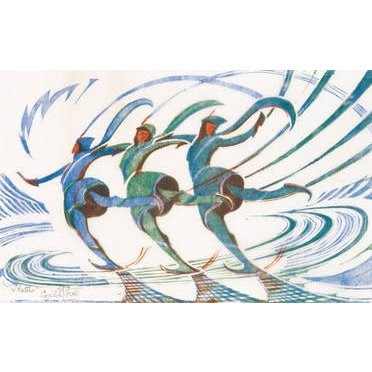
Another thing I loved about Power's work was that he signed, in pencil, each one of his prints, and also marked which number each print represented in the series. Not only did each print bare the mark of its maker, but these markings contributed a certain aura to an image that some might consider to be void of the presence of the artist. If you look hard enough, you can see all of Power's markings in the corners of his images.
Friday, September 19, 2008
Persona
 Imagine spending all of your time with someone who refuses to speak. How would you react? Would you yourself cloister, decide to live a life of silence, refusing to interact minus gestures? Or, as is the case in Ingmar Bergman's Persona (1966), would you feel safe with the silent one, provoking reactions just to engage her in a conversation, delving deep into your past, your psyche, your pool of emotions if only for the hope of momentary connection, reciprocation and understanding? Anyone who has fallen victim to the soul-wrenching heartache of unrequited love will no doubt identify with Nurse Alma (Bibi Andersson) as she bares her soul to Elisabet (Liv Ullmann), an actress who has suddenly decided to "play the role" of a mute. The word Alma in Spanish means soul, a highly appropriate title for a character whose soul pours out every orifice from the very beginning of her interaction with Elisabet.
After showing a camera beginning to operate and exposing the nature of the projector, Bergman becomes highly experimental. The film begins with almost Eisensteinian montage sequence complete with very rapid cuts to textural, visceral, cold and sharp-edged vistas and scenes, all intended to remind the viewer they are indeed watching a film. All of these scenes are juxtaposed in such a way to make you aware of the beauty in the odd, the nature of the projector, and indeed the nature of filmmaking and screening itself. Some of these images are intended to evoke subliminal messages, others are present for their sheer beauty on screen. Slowly, the random events devolve into close-ups on different objects in a house, and it is a very sterile house indeed. Much of the film contains very sterile, cold, undecorated places until Elisabet and Alma begin their stay at the beach house.
Much can be said about the relationship between the two, but I wouldn't want to give too much away. It is at times intimate, at times malicious, at times filled with lunacy, sometimes even desperation. Bergman's cinematographer Sven Nykvist has a tendency to shoot in close-up, making watching this film on even the smallest of television screens effective, relateable, and intriguing. Both women betray one another, both women part without resolving their conflict, without apologizing, going their separate ways and on with their confused, somewhat broken lives.
Nykvist is almost as much responsible for the overall execution of this film as Bergman. Every single frame could be a photograph. Every one. The way he plays with lighting and shadows is almost painterly. He is a master of the wide shot, and even more so of the close-up. A friend watching this film with me described an essay he read about the way the Bergman-Nykvist team use the face as a landscape, which I think is the best way to describe some of the more intimate moments of high contrast, lingering close-up shots; using the contours of the face (the nose, the lips, the chin, the curve of the forehead) as a masking device as well as its own scenic vista.
Although highly experimental in nature, even jarring the audience half way through the film to remind them they are in fact watching a film by burning out the celluloid and cutting the minimal score, this film is visually a work of art. The majority of the dialogue exists in monologue, with Alma reaching out for Elisabet to open up the way she has with her, every bit of it well-crafted, insightful, beautiful prose. I'll leave you with an example of this; a speech given by a female doctor (one of the other three characters in the film besides the two women) to mute Elisabet explaining her personal grasp of the desperation of introspection and the human condition:
I understand, all right. The hopeless dream of being - not seeming, but being. At every waking moment, alert. The gulf between what you are with others and what you are alone. The vertigo and the constant hunger to be exposed, to be seen through, perhaps even wiped out. Every inflection and every gesture a lie, every smile a grimace.
Saturday, September 13, 2008
Media As Extentions Of Man

(In response to an essay written in 1964 by Marshall McLuhan entitled "The Medium is the Message." This guy basically predicted the invention of the internet some 3 years after writing this essay. I would say he's someone to whom I should pay special attention.)
I believe that we need to be aware of our social context in a world of ever-changing technology, but we also need to be even more aware of the fact that "the 'content' of any medium blinds us to the character of the medium" (106), to the inherent nature of the medium. This sort of goes along with General David Sarnoff's statement "we are too prone to make technological instruments the scapegoats for the sins of those who wield them" (109). I think McLuhan is making the argument that technology does more than just add itself on to what we already are; it actually becomes part of us, or at least part of our sensory world. Separating ourselves from media in the way that Sarnoff is doing "ignores the nature of the medium" (110); he's essentially placing no relationship between the connectedness of media, our senses, and self.
What is the purpose of presenting information in any designated way? Why do we deliver some messages visually, others textually, and still others sonically? Why do we choose these specific media to deliver these specific messages? The message of a film is different than the message of film itself. McLuhan states that the message encoded within the medium of movies is "that of transition from lineal connections to configurations" (110). In this way, the message of film itself is steeped in history, in the representation of progress, and the concepts of cubism. "Cubism sets up an interplay of planes and contradiction or dramatic conflict of patterns, light, textures that 'drives home the message' by involvement" (111). Therefore, the message of the medium of cubism (in both film and static art) is of a world of structure and of configuration.
We package messages within media because of their effectiveness in this specific method of presentation. The message that a particular media is sending (this is independent from the content) relates mainly to our sense lives, which McLuhan states are in fact extensions of our self.
Friday, August 8, 2008
A brief reaction to Twin Peaks thus far

Ok, so it is David Lynch, which means I shouldn't try to read in to every little thing. But I can't help it!
**Spoiler alert...but if you don't care, read on.
The title of the show alone evokes similarities from all his films; he loves incorporating the "doubles" concept, especially when it's good vs. evil, light vs. dark. There's the Double R Diner, where Shelly and Norma, both pretty blondes who have criminal husbands AND slightly more tame, caring affairs, work as waitresses. There's Laura Palmer's cousin Maddy, who is simply actress Sheryl Lee with darker, bigger hair and huge glasses. These are the more obvious sets of "twins" in the town of Twin Peaks; one could also draw parallels, twin-like and opposing characteristics between Special Agent Dale Cooper (Kyle MacLachlin) and Sheriff Harry S. Truman (Michael Ontkean), both from branches of law inforcement who each contribute their own talents and knowledge to solving the case of Laura Palmer's death.
Lynch also loves to incorporate his own problems with intersocial communication into his work; both Laura and Agent Cooper speak into tape recorders instead of on the phone or face to face with a physical person (Dr. Jakoby and Diane, respectively). The dwarf character (billed as "The Man From Another Place", played by Michael J. Anerson of HBO's Carnivale) who appears in Agent Cooper's dream speaks and moves backwards; Lynch then reversed the film and audio so that he moves awkwardly and is subtitled because his speech is nearly indecipherable.
It's interesting to me that the intro sequence in the pilot is significantly longer than the sequence for the rest of the series. The pilot intro involves far more graphic, violent imagery, with mill equipment being sharpened. One is almost inclined to draw parallels, if you read into it enough, between the pilot intro and the opening credit sequence in Dexter, a show that also centers around violent, underworld subject matter. But starting with the first hour-long episode of the series, creaters Lynch and Mark Frost opted to showcase more beautiful, serene images, with flowing rivers and waterfalls. These pictures of water could also be seen, in an afterthought, as quite disturbing, since Laura's body was found washed up on the river's shore. (Watch it here, I couldn't figure out how to embed http://www.youtube.com/watch?v=7oDuGN6K3VQ)
I've been watching the show on DVD, and am currently on Episode 6 (if you count the pilot as episode 1). So far the Pilot and Episode 6 have been the best. I've heard I should expect a downhill spiral from here, filled with cliches and nonsense. I hope Lynch has the common decency to tie up loose ends, but then again, he generally hates his audience, so we'll just have to see.
Subscribe to:
Posts (Atom)